



Corrugated Conduit: Ultimate Buyer’s Guide
Author: Electrical Specialist Editorial Team at ekabel24.de
Created: May 28, 2026
Last Updated: May 28, 2026
Corrugated conduit, also known as flexible cable protection tubing or empty conduit, is an essential component in modern electrical installations. It protects cables from mechanical stress, moisture, dust, and other environmental influences while enabling clean, standards-compliant wiring. In this comprehensive guide, you will learn everything you need to know about corrugated conduit — from the different types and applications to essential accessories such as pipe clips and sealing plugs.
What is Corrugated Conduit and Why is it Essential?
Corrugated conduit is made of robust plastic (usually HDPE or PVC) and features a characteristic ribbed surface. This design provides high flexibility while maintaining excellent crush and impact resistance. It serves as a protective sleeve for power, data, and control cables and makes it much easier to install or replace cables later.
At ekabel24.de you will find high-quality corrugated conduits in standard sizes from M16 to M40 with compressive strengths up to 750N — ideal for indoor, outdoor, and underground installations.
Advantages of Corrugated Conduit at a Glance
- High flexibility for tight spaces and complex routing
- Robust protection against mechanical impact, moisture, and UV radiation
- Easy cable insertion thanks to integrated draw wire
- Compliant with DIN EN 61386 standards
- Durable and low-maintenance
Types of Corrugated Conduit: Comparison and Selection Guide
Corrugated conduits mainly differ in material, compressive strength, and fire protection properties. Here’s a direct comparison:
| Type | Compressive Strength | Material / Properties | Typical Applications |
|---|---|---|---|
| Standard Corrugated Conduit (with draw wire) | 750N | HDPE / PVC, UV-resistant | Indoor/Outdoor, Underground, Concrete |
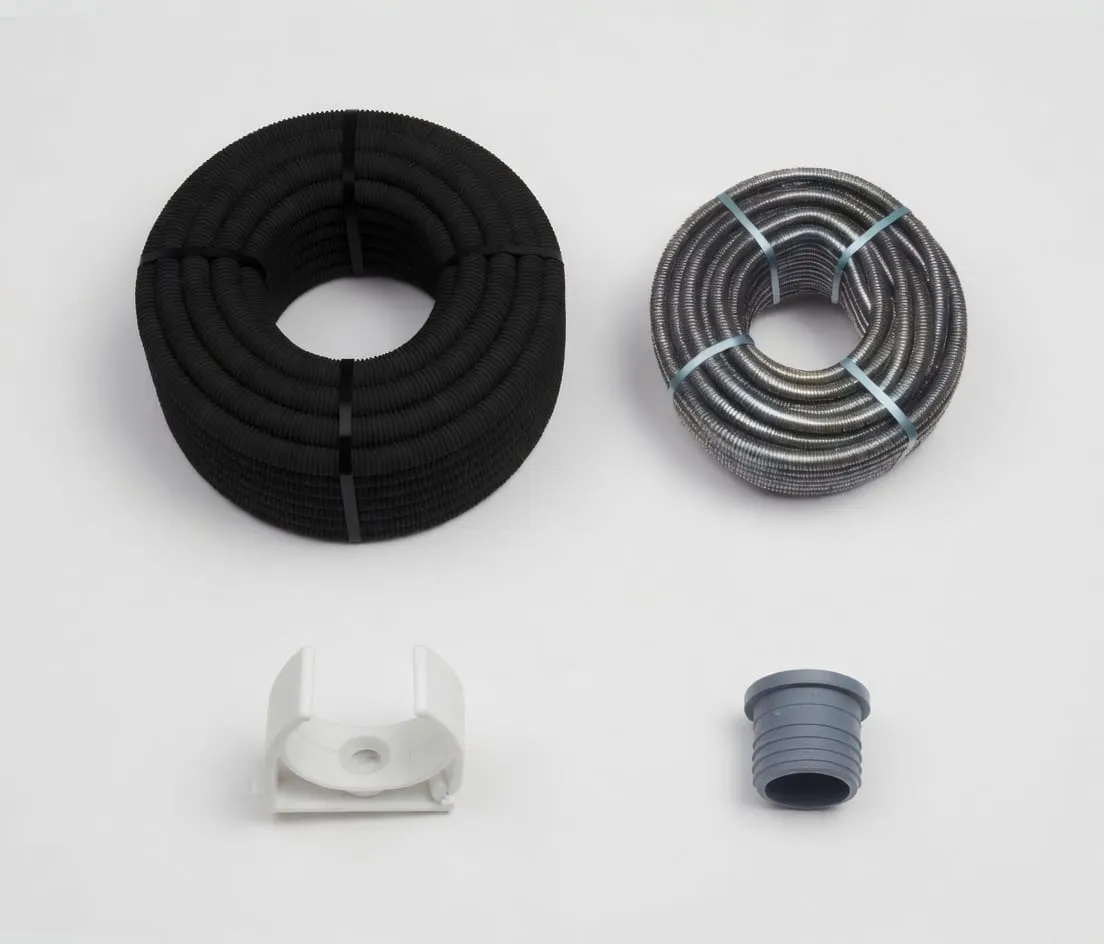
| Halogen-Free Corrugated Conduit | 320N | Special polymer, flame-retardant, low smoke emission | Public buildings, Industry, Van Conversions |
| Lightweight Corrugated Conduit | 320N | Highly flexible, for indoor use | Under plaster, Hollow walls |
Explore the full range of corrugated conduits, available with or without draw wire, in various lengths and colors.
Applications of Corrugated Conduit
Corrugated conduit is extremely versatile:
- Building Installations: Under plaster, surface-mounted, in screed and concrete
- Underground Installations: Protection of buried cables from mechanical stress
- Photovoltaics & Heat Pumps: Safe routing of DC and AC cables
- Industry & Mechanical Engineering: Dynamic applications
- Van Conversions: Vibration-resistant vehicle electrics
Essential Accessories for Professional Installation
Pipe Clips – Secure Fixation
Pipe clips ensure vibration-resistant and tidy mounting of corrugated conduits on walls, ceilings, or floors.
Sealing Plugs – Airtight Sealing
Sealing plugs with pierceable membrane prevent condensation, drafts, and dirt ingress. Perfect for professional, standards-compliant installations.
Tips for Choosing and Installing Corrugated Conduit
Select the nominal diameter (M16–M40) according to the number and cross-section of your cables. Consider compressive strength, temperature range, and whether halogen-free material is required. During installation, always maintain the minimum bending radius and use the draw wire where possible.
Frequently Asked Questions (FAQ) about Corrugated Conduit
What does the compressive strength (e.g. 750N) mean?
Compressive strength indicates how well the conduit can withstand mechanical loads (e.g. in concrete or soil). 750N versions are suitable for underground and concrete installations.
When should I use halogen-free corrugated conduit?
Halogen-free conduit is recommended in areas with high fire safety requirements, as it does not release toxic gases and produces minimal smoke in the event of a fire.
Is corrugated conduit suitable for underground use?
Yes. Special 750N versions reliably protect underground cables against moisture, frost, and mechanical damage.
Which size of corrugated conduit do I need?
For standard residential installations, M20 or M25 is usually ideal. For multiple or thicker cables, choose M32 or M40. Use the inner diameter tables on the product pages for guidance.
Do I always need a draw wire?
A draw wire (pulling aid) greatly simplifies cable insertion, especially over longer distances or during retrofits.
How do I properly fix corrugated conduit?
Use matching pipe clips for a stable and professional installation.
Which standards do the corrugated conduits at ekabel24 meet?
All products comply with DIN EN 61386 and carry the CE marking for safe electrical installations.
Conclusion: Corrugated conduit is the smart solution for safe and flexible cable protection. Discover the full range in the Corrugated Conduit Shop, including halogen-free versions, fixings, and sealing solutions.
For individual advice on your project, feel free to contact the ekabel24.de team.